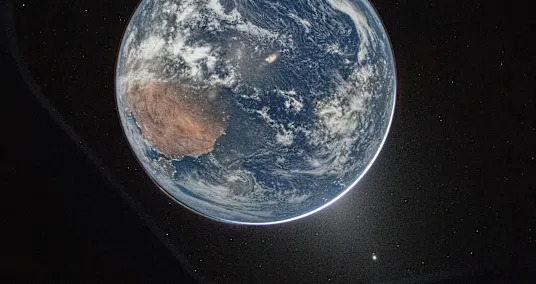
CAPE CANAVERAL, Fla. (AP) — The Artemis II astronauts have captured our blue planet’s brilliant beauty as they zoom ever closer to the moon.
NASA released the crew’s first downlinked images Friday, 1 1/2 days into the first astronaut moonshot in more than half a century.
The first photo taken by commander Reid Wiseman shows a curved slice of Earth in one of the capsule’s windows. The second shows the entire globe with the oceans topped by swirling white tendrils of clouds.
As of midmorning Friday, Wiseman and his crew were 90,000 miles (145,000 kilometers) from Earth and were quickly gaining on the moon with another 168,000 miles (270,000 kilometers) to go. They should reach their destination on Monday.
The three Americans and one Canadian will swing around the moon in their Orion capsule, hang a U-turn and then head straight back home without stopping. They fired Orion's main engine Thursday night that set them on their course.
They're the first lunar travelers since Apollo 17 in 1972.
___
The Associated Press Health and Science Department receives support from the Howard Hughes Medical Institute’s Department of Science Education and the Robert Wood Johnson Foundation. The AP is solely responsible for all content.
LATEST POSTS
- 1
 Famous Restroom Beautifying Styles For 2024
 - 2How comfort foods trigger pleasure in our brains
- 3PHOTO ESSAY: Scientists trying to unravel one of the body's biggest mysteries
- 4Greenland’s melting ice and landslide-prone fjords make the oil and minerals Trump is eyeing dangerous to extract
- 5What causes RFK Jr.’s strained and shaky voice? A neurologist explains this little-known disorder


- Council removes proposal to rename park named after former president of Israel
- Find the Abilities Required for Advanced Advertising Position
- The most effective method to Distinguish the Best Material Organization in Your Space
- Pick Your Favored kind of sandwich
- 75% of US adults may meet criteria for obesity under new definition, study finds
- Vote in favor of the handheld vacuum that you love for its strong attractions!
- Everything you should know before booking a trip to Spain
- Select Your Go-To Bluetooth Earphones
- CPA Canada appoints eight directors as new governance model takes effect