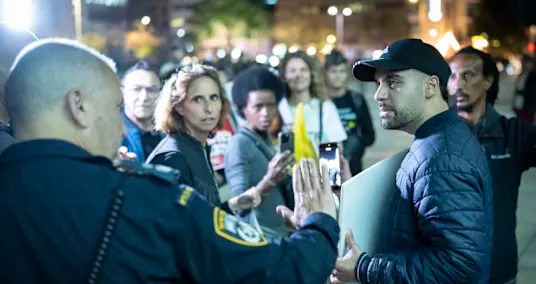
Protests took place in Tel Aviv, Jerusalem, Haifa, and Beersheba, as a survey found broad but uneven support among Jewish Israelis for Operation Roaring Lion.
Israel Police arrested 21 anti-war protesters Saturday night as demonstrations against the conflict with Iran expanded in multiple cities despite restrictions on public gatherings.
Protests took place in Tel Aviv, Jerusalem, Haifa, and Beersheba, with hundreds of participants reported in Tel Aviv and Jerusalem and about 100 in Haifa, marking the largest turnout since weekly demonstrations began. Authorities said 13 people were arrested in Tel Aviv and eight in Haifa.
Police said the gatherings were not approved under Home Front Command regulations that ban events with more than 50 people. Officials said the increase in turnout followed calls by groups opposing the government to protest despite the restrictions.
“During a situation assessment that took place at the scene with a Home Front Command representative… it was clarified that there was a real risk to human life and accordingly, Yarkon [precinct] police commander Tzachi Sharabi ordered the gathering to be dispersed,” police said.
Hadash-Ta’al chairman Ayman Odeh, an Arab lawmaker involved in the protests, criticized the police response, calling officers fascists “in the service of the government” and saying they were afraid of “the heroic citizens who went out, despite everything, to make their voice heard.”

Survey shows broad, uneven support for war
The demonstrations come as a March 2026 survey by the Israel Democracy Institute found broad but uneven support among Jewish Israelis for Operation Roaring Lion. Support was strongest on the Right at 87% and about half on the Left.
The survey also found that Jewish and Arab respondents largely agreed that Iran’s resilience has been stronger than expected. Most Jewish respondents said Israeli society could sustain the campaign for up to one month, while 28% said as long as needed. Arab respondents were less optimistic about how long the public could endure the conflict.
A majority of Jewish respondents said Prime Minister Benjamin Netanyahu’s decision was driven by security considerations, while most Arab respondents viewed it as political.
LATEST POSTS
- 1
 A hunger for new experiences Narratives: Motivating Travel and Experience
 - 2Scientists map of old Mars river basins for the 1st time. These could be great places to search for ancient life
- 34 Excellent Remote Headphones of 2024
- 4Strengthening through Wellness: Individual Preparation Achievement
- 5What will happen if Artemis 2 astronauts get hit by a solar storm during NASA's ambitious moon mission?



- The Most Compelling Books of the 10 years
- Our 10 favorite Space.com reader astronomy photos of 2025
- ‘Extraordinary’ Iron Age war trumpet uncovered in England
- What is Fusarium graminearum, the fungus a Chinese scientist pleaded guilty to smuggling into the US?
- The Tradition of Stone: A Gander at Notable Structures Through the Ages
- Qatar LNG Ships U-Turn After Attempt to Pass Through Hormuz
- California is completely free of drought for the first time in 25 years
- My daughter is in the #1 movie in the country. She still has to finish her math homework.
- How to watch 'Tell Me Lies' Season 3: Episode release times, streaming info and more